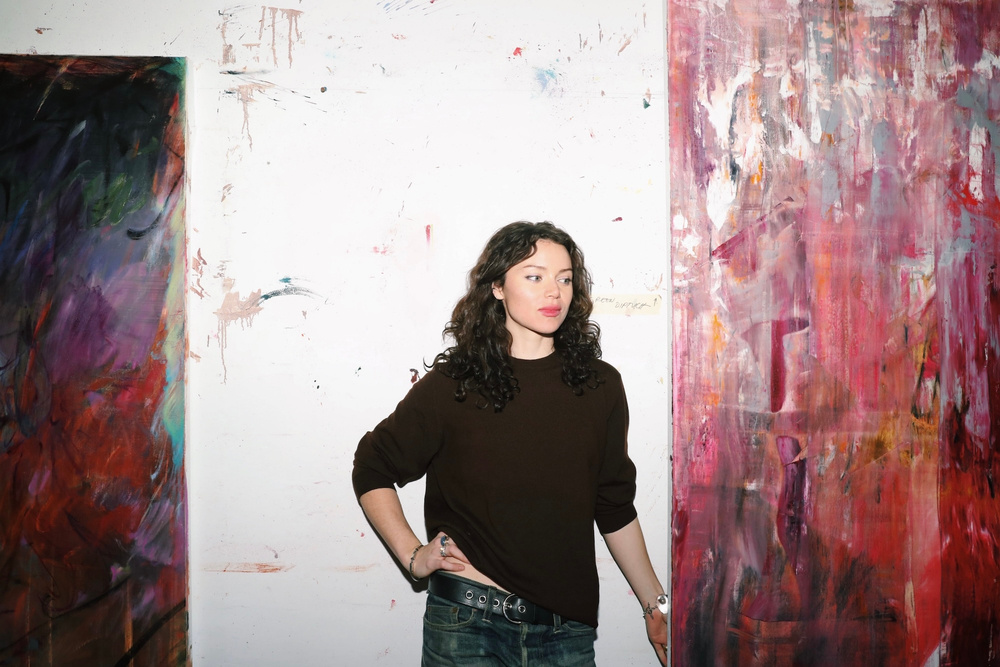
Caroline Absher holds a BA Art History Degree and a BFA Painting Degree from Pratt Institute in Brooklyn, NY. In recent years, Absher has become known for her energetic and highly intuitive paintings that shift styles and techniques in search of an ecstatic iteration of her subjects and their surroundings. Equal parts abstract formations and lyrical brushwork, her paintings draw on the artist’s time as a solo world traveller, in-depth study of art history, and her early years in New York City spent building frames of colour and texture in the third dimension on movie sets. Absher’s paintings are often full of mesmerising figures wrapped in rich atmosphere, employing transparent washes and musical strokes to articulate epic natural phenomena and human wonder. In her most recent work, images may leap out or hide for a while, depending on the day, light, and mood of the viewer. Rather than capturing a version of reality, Absher brings the transcendental and subconscious world to life, bridging the gap between external and internal, inferring a collective and infinite ephemerality. Highlights of recent solo exhibitions include ‘Back to Oz’, Fredericks & Freiser, NY (2023); The Journal Gallery at Tennis Elbow, NY (2022); ‘Earthbound’, Makasiini Contemporary, Turku, Finland (2022). Recent group exhibitions include ‘City Life’ with V1 Gallery, Copenhagen, Denmark (2024); ‘Apocalypse Now’ with The Journal Gallery, Patmos, Greece (2023); ‘Botany of Desire’ with Swivel Gallery, NY (2024), and ‘Women of Now’ with The Green Family Art Foundation, Dallas (2021). Her work is in the permanent collection of The Portland Museum of Art, USA. Caroline is represented by Fredericks & Freiser in New York.
Pour aujourd’hui et pour l’avenir: Absher, Bonnard, Fell
20 – 26 October 2026
Private view: Monday, 19 October, 6 – 8 pm
8 Square Sainte-Croix de la Bretonnerie
75004 Paris
France
Caroline Absher, Pierre Bonnard, Annice Fell
AN ESSAY BY MATTHEW HOLMAN
LBF Contemporary is pleased to announce Pour aujourd’hui et pour l’avenir, an exhibition bringing together an intimate work on paper by Pierre Bonnard with new paintings by Caroline Absher and Annice Fell, made in direct response to his work. Across generations, the three share a belief in colour as a carrier of feeling and memory.
In 1892 Pierre Bonnard sat his younger sister Andrée at the dinner table in a red gingham blouse and let the cat up beside her. He was twenty-four, and Japan had dazzled him: woodblock prints at Siegfried Bing’s in 1888, then a whole exhibition at the École des Beaux-Arts in 1890. His fellow Nabis called him le Nabi très japonard. The finished canvas, now in the Musée d’Orsay, has the shape of a kakemono, a Japanese hanging scroll twice as tall as it is wide, and the checks lie across Andrée as flat as a print. This sketch, once Édouard Vuillard’s, is where it began. Every decision is still wet.
For a century or more Bonnard has been filed under charm; an artist of fleeting sensation, of dappled sunlight in mahogany apartments. Sargy Mann, the painter whose life Bonnard changed, called that ‘a common misconception’ and ranked him ‘on a par with Matisse and Picasso’. In The Bowl of Milk (c.1919) Mann found ‘two eye levels’, one peering down at the table and ‘a much lower one looking across at the girl’. In 1892 Bonnard was already at it: the tabletop tilts towards us while we look up at Andrée, her body built from flat layers and looping lines. She still has weight, still shows how the artist has a striking ability to allow colour to find form.
Bonnard painted from memory, prompted by tiny pencil drawings on squared maths paper or the flimsy sheets of invoice books. Mann studied closely how those drawings became paintings and noticed how much moved on the way to the canvas. Proportions stretched and compositions shuffled until scarcely a single object kept its original shape, and yet, as Mann wrote, ‘in some mysterious way it is always the very same experience’. Set this squat card beside the tall scroll that now hangs in the Orsay and you can watch that change happen: the scene is drawn upwards into a new format while Andrée, at her table, stays unmistakably herself. More than four decades later, in his diary for 1934, Bonnard set the method down in a single line, resolving to ‘profiter des hasards ou plutôt des imprévus’ (make use of accidents, or better, the unforeseen) and adding that he would need to understand them afterwards.
Two painters in this room live by that line. Caroline Absher, born in 1994 and working in Brooklyn, begins each canvas with what she calls ‘a big aimless abstraction using every color of the rainbow’. She then stares at it, searching for anything she may have done without meaning to, until, in her words, ‘the painting appears’. Her favourite moment comes when a picture that has failed lets her ‘bring it back to life’. Bonnard would have recognised the phrase: in 1946 he described his own ambition as ‘rendre vivante la peinture’, to bring painting to life. On the two small canvases here the figures have already surfaced. In Wild Child a body drawn in rust-brown strokes rises from a bank of white mist against magenta and smoky violet, like one of Bonnard’s bathers glimpsed in a steamed-up mirror. In Celeste a few curling red marks and two dark dots on a peach ground resolve, if you let them, into a creature turning to look back at you. The two large canvases keep their figures in suspense. Cosmic Dancer sets a glowing oval of cream and gold inside a dark plum surround. Conjurer, over a metre and a half tall, stops just before the reveal: flesh-pink and cream are dragged down it like a stage curtain, while charcoal strokes gather at its foot like a magician’s hands. Absher once summed up her practice as ‘that magic is real’, and Bonnard, who kept canvases for years while he waited for their marks to turn into things, would have agreed.
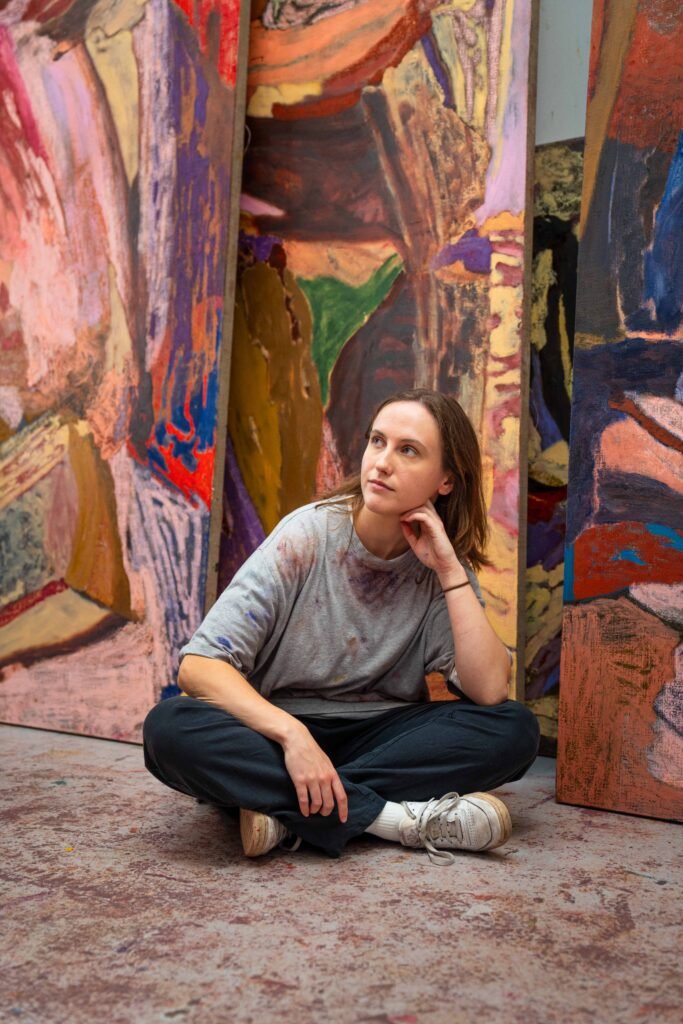
Annice Fell, born in London in 1997, trained at the Slade and then the Royal College of Art. She works oil and oil pastel into linen in knotted, roped strokes, and some are monoprinted onto the surface, so their edges fray like a tideline. Harbour and Torso are knotted from the same salmon pinks and olive greens, as though Fell had cut both pictures from one length of cloth. Harbour stands more than two metres tall, and the seam between its two stacked panels falls where a waterline might. In Torso the same bands curve into something like a ribcage, so that a body and a waterfront are built from one set of gestures, much as Bonnard built Andrée and her tablecloth from the same dabs of paint. Night brings out her violets. A hard purple recurs from top to bottom of the three stacked panels of Nightscape, and the critic Peter de Bolla’s phrase for Bonnard’s colour, ‘visual harmonics’, fits it exactly. In Bonnard’s La Salle à manger, de Bolla traced the orange of Marthe’s arm into the wall and window frame, as if looking at one region ‘sets in motion another, perhaps distant region of the painting’. Fell’s colour travels across her panels in the same way. Her title the moon shines in all around just as the sun does would have pleased a painter who, as Mann recalls, told a young artist: ‘Light is our God, young man.’
At 23.5 centimetres, the Bonnard is the smallest thing in the room, a scrap of card hung among canvases up to nine times its height, and yet it holds its own against all of them. Mann ended his essay by catching himself ‘marvelling at the blueness of this writing paper reflecting the autumn sky’, and then he added a simple line of gratitude: ‘I have Bonnard to thank for this too.’ Give Andrée ten minutes before you turn to Absher’s pinks and Fell’s violets, long enough for the dabs of her blouse to settle into a young woman at a table. You’ll find yourself looking at the new paintings, and perhaps at the Paris street outside, the way Mann looked at his writing paper.