An essay by Matthew James Holman
Call Lawrence Perry a reactionary. He has grounds to object, though not many. Here is a painter who will spend weeks by hand on court dress in cream and rose silk, a ribboned bodice studded with pearls, stained glass seen from the dim side of a bright afternoon, cut flowers going off like flashbulbs in the dark, at a moment when any of those things can be had from a text box in the time it takes to type the prompt.
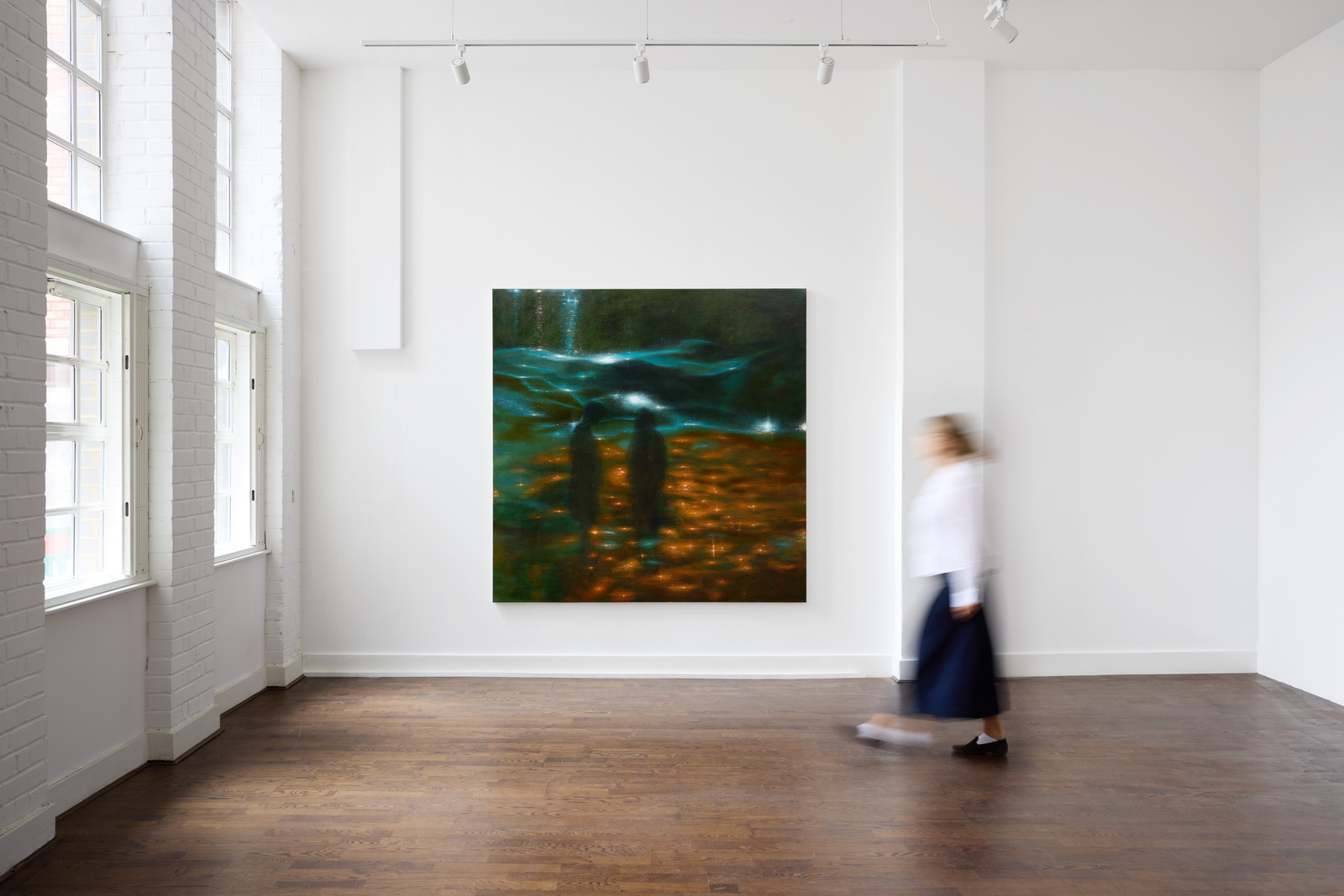
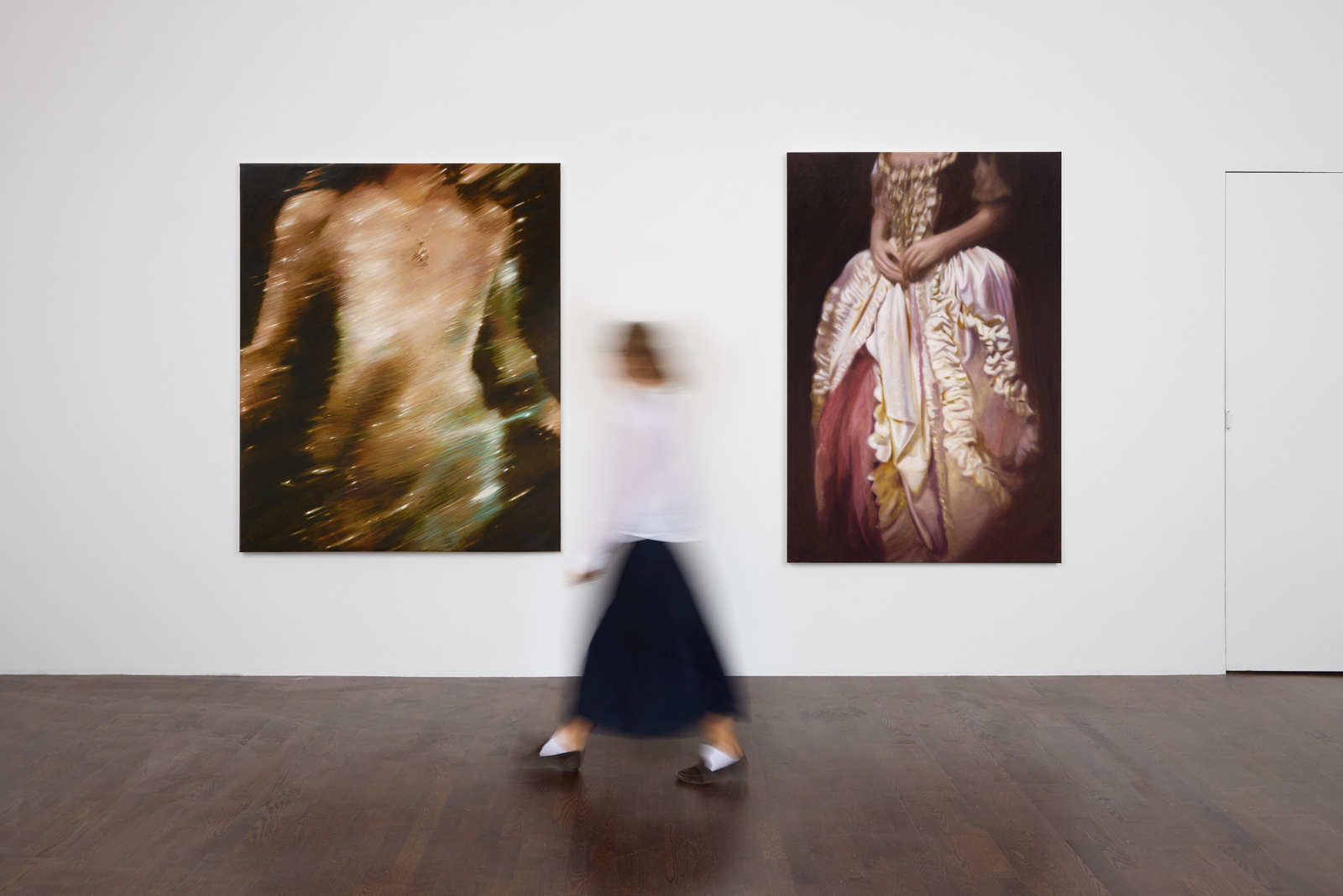
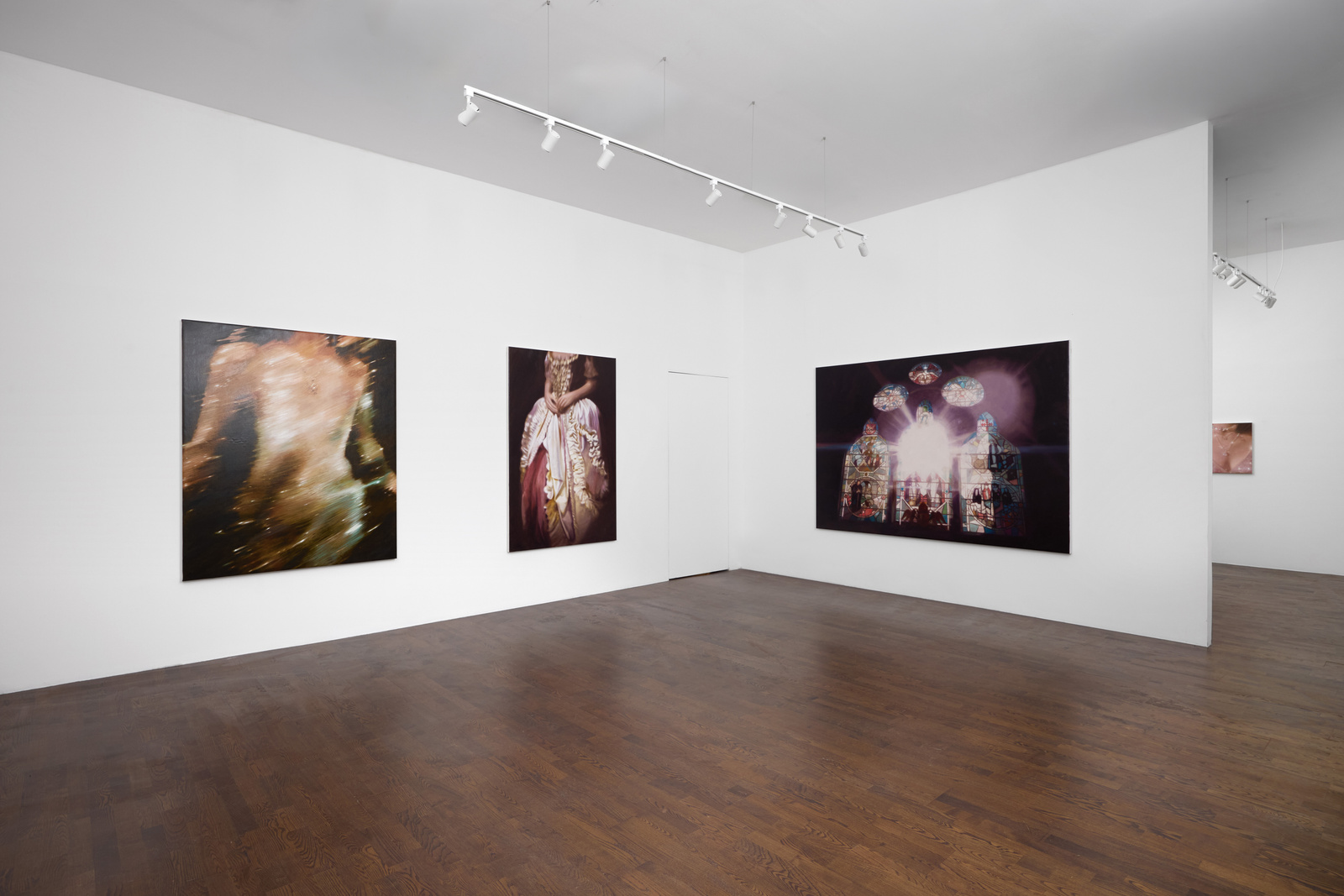
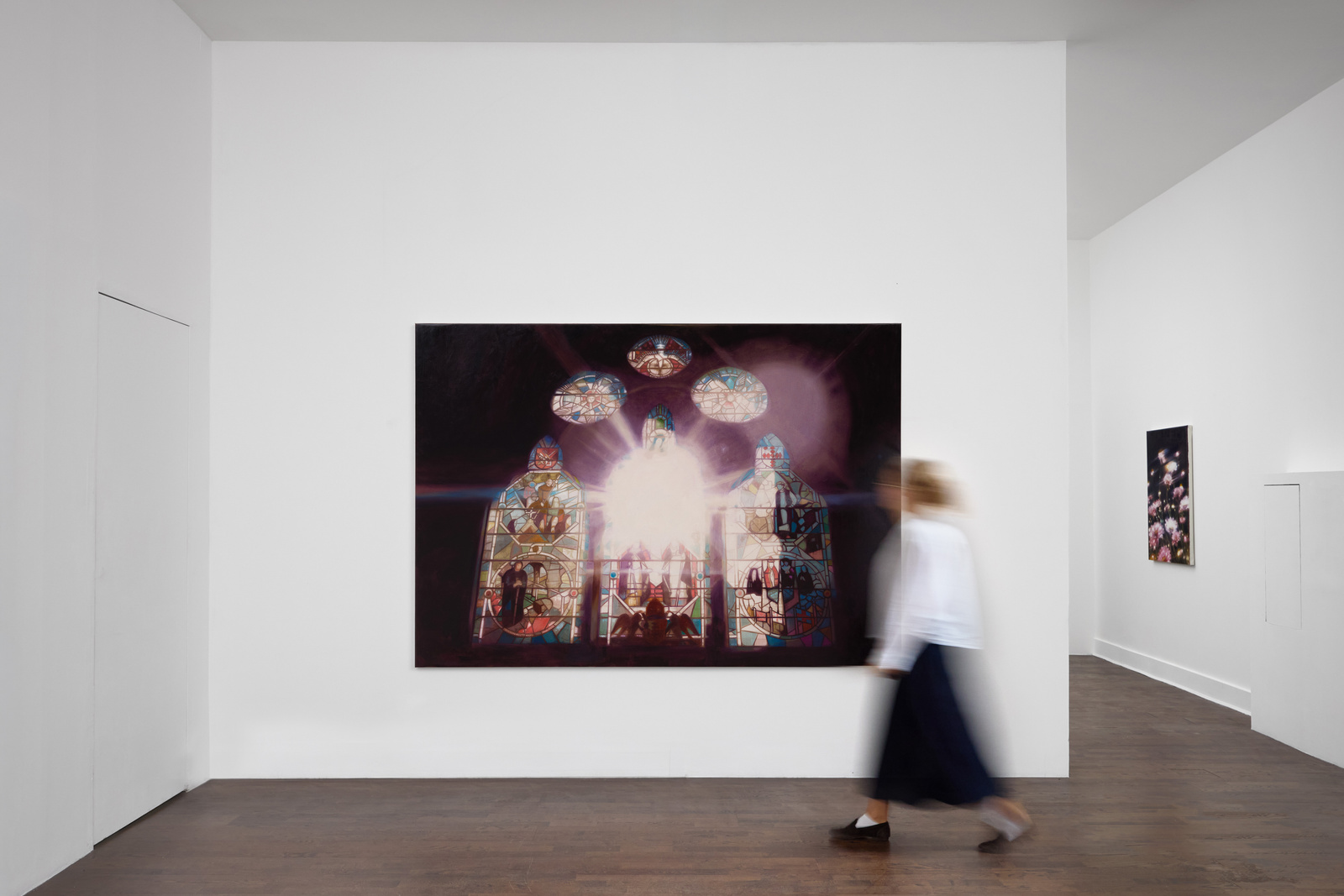
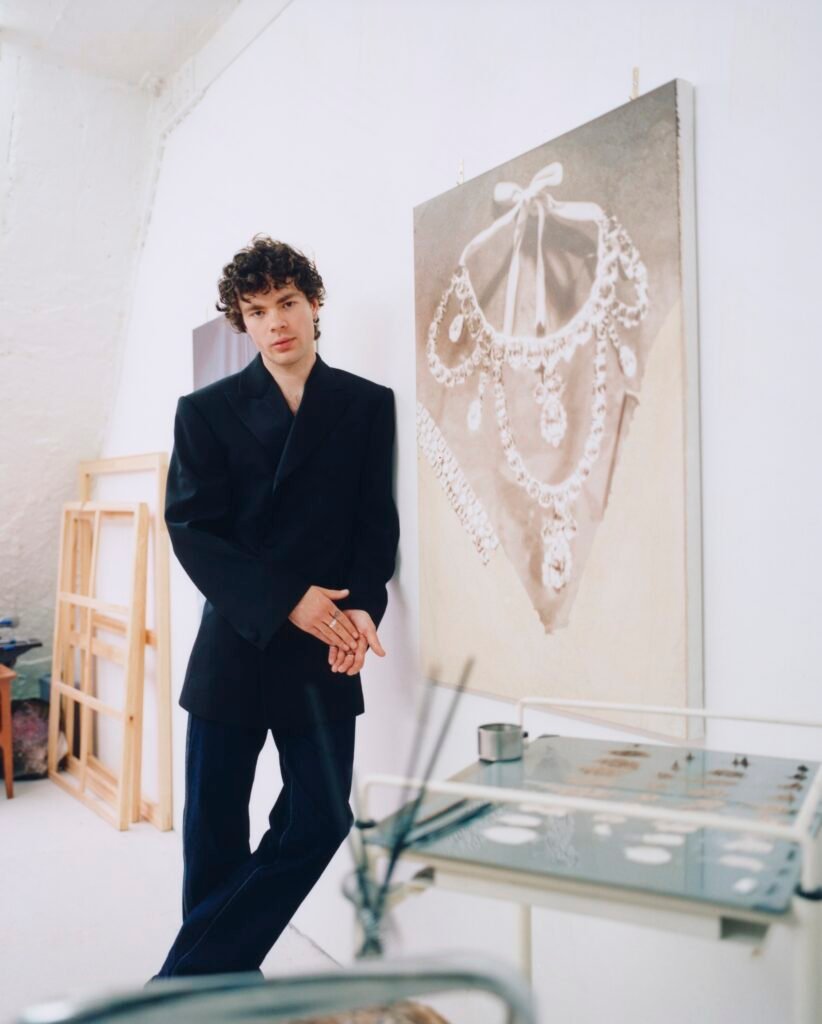
The compositions and the colour, even the gestures, belong somewhere outside our time. His pictures run counter to the generative image-making of the day; they are sensuous and gaudy in a decadent, fin-de-siècle way, they are about irretrievable experience and the body’s appetites, but they are also about the production of images, and our temporal experience of encountering them. Perhaps what he wants back is more recent than the devotional paintings of Memling, or the chivalric daydreams of the Pre-Raphaelites. It is the old arithmetic of the photograph: thirty-six frames on a roll, a fortnight’s wait before you knew whether you had it. So he damages the pictures, with immaculate attention to how the oil moves. Motion blur drags a torso sideways into its own afterimage. Blown highlights eat the centre of a church interior until the windows dissolve. Above all, Perry is a neo-Romantic working in a photographer’s vocabulary, and the faults he paints in are the ones the camera industry sought to engineer out: coated lenses to kill the star-burst, faster emulsions and stabilised sensors to kill the blur, finer and finer grain, and now the phone that sharpens and denoises every picture before you have seen it. He puts the defects back by hand, in oil, one at a time, over weeks. The cumulative effect is a series of paintings about the ‘careless rapture’ of a first encounter, staged long after the encounter is over, by a young man who knows perfectly well that staging is the one thing carelessness cannot withstand.
Unsurprisingly, Perry has been reading his Victorian poets. The wise thrush in Robert Browning’s ‘Home-Thoughts, from Abroad’ sings each song twice over, ‘Lest you should think he never could recapture / The first fine careless rapture!’ The poem sets a remembered English April against a southern present, and a forlorn ache sighs through the lines. That burdened repeated rhyme is form playing as content. A rapture recaptured has become deliberate and has lost the involuntary abandon of the first time (and we all remember the first time). It takes studied care to restage carelessness, in part because to recall such experiences implies a desire for a return that the recollection itself forecloses. What comes back has already been handled. We seldom regret what we once did, but what one cannot do again.
It feels apropos that Browning’s lines have been taken by Perry, an artist who, in his old-soul disposition and in the deliberate anachronism of his paintings, appears caught between different temporal states. The works of Perry’s last exhibition, They Shoot Horses Don’t They? at LBF Contemporary in 2025, were also interested in the source material of first encounters: fable, mythology, the children’s storybook, scenes met before we had any means of examining them. He pictured those paintings as theatrical and staged, figures caught mid-thought or mid-transformation, familiar enough to recognise and wrong enough to distrust, and disconcertingly out of sync insofar as they hold a wholly contemporary subject inside a much older picture. For Perry, many of these new works belong to what he has called ‘transitional periods of loss or reinvention, moments where something was either slipping away or just arriving’, as he has sought to remain present enough to ‘recognise the raptures’ as they happen, in which ‘a process of intentional introspection forms the emotional undercurrent of the exhibition.’ Indeed, it is easy to see, even on those glimmering surfaces that reveal half-truths of things, as they were, or as they never were but have been recalled in the mind as such, that Perry is an artist invested in the conditions of nostalgia. Hofer meant it as a diagnosis, and for two centuries it was one, a sickness that could waste and occasionally kill the sufferer who was kept too long from home. It has since been rehabilitated into something closer to a resource, a way of keeping the absent within reach, and the older sense has never quite left it. Perry’s paintings hold both.
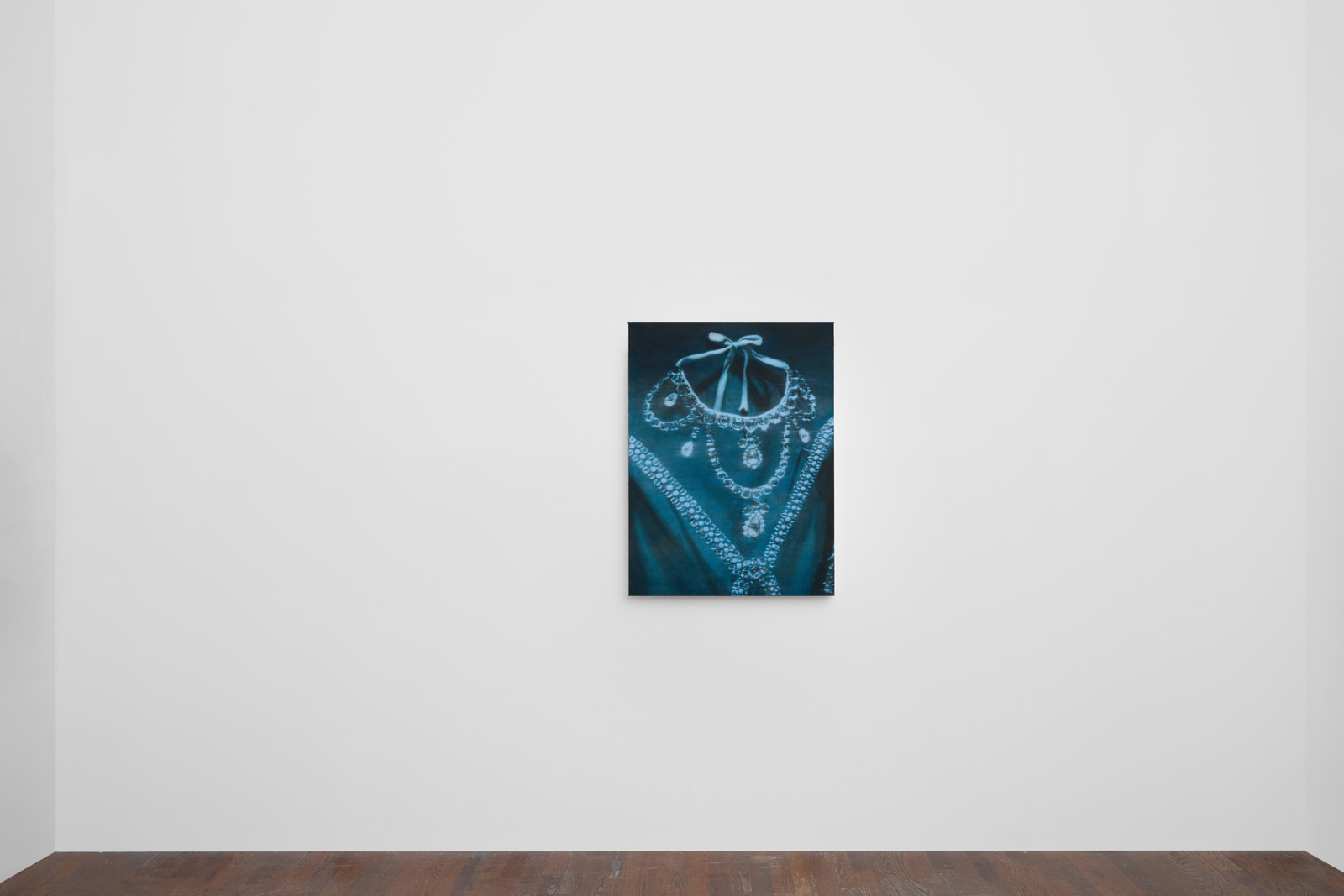
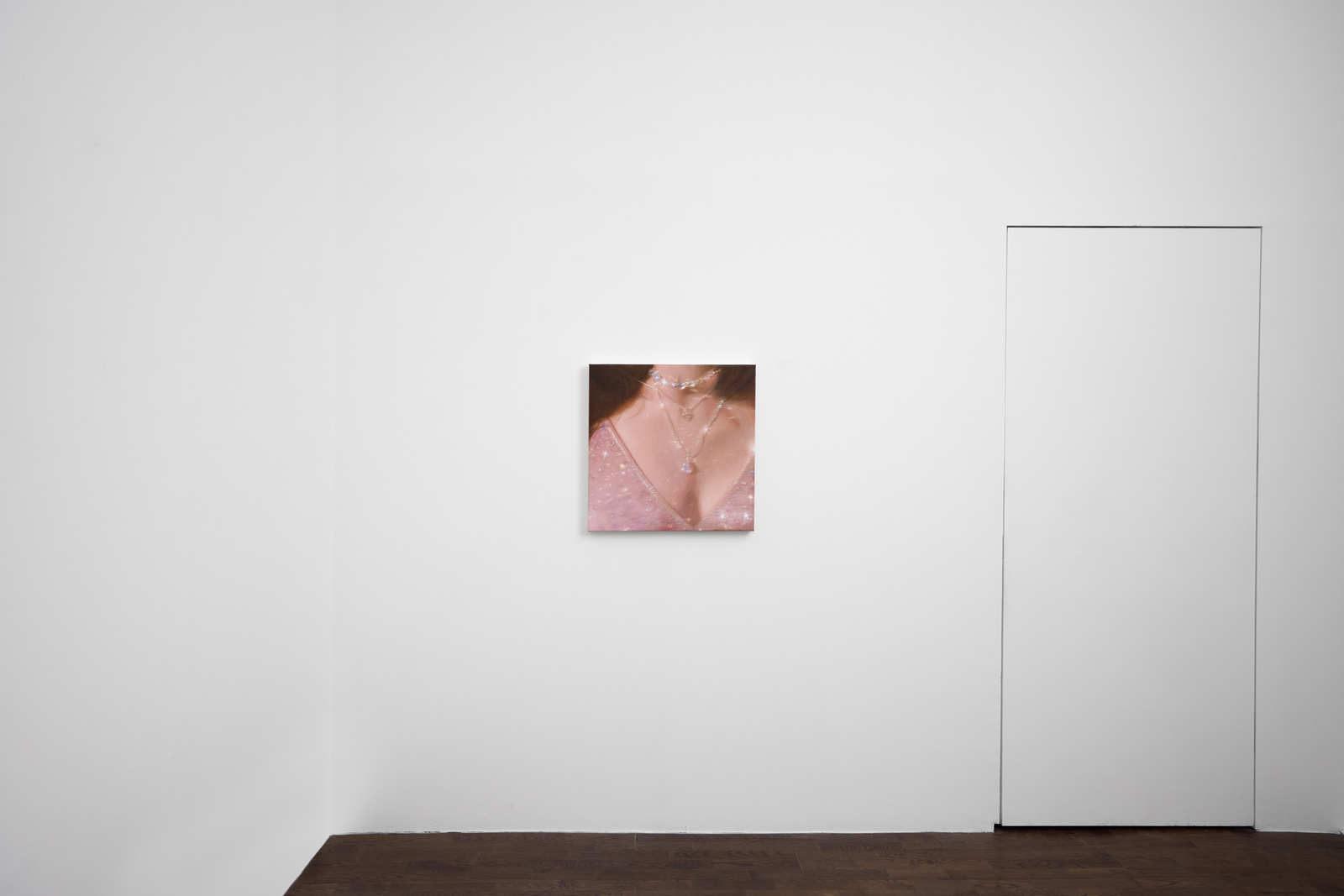
If nothing else, this body of work looks nostalgic. Perry has himself discussed his desire, in this series, to ‘bottle up the beauty in nostalgia and repurpose its power.’ The formal nostalgia is worked and reworked. He paints the accidents that make an image look like something retrieved: the four-pointed star-burst of a cheap lens, film grain crawling over a figure in a white dress. Monochrome does the same job by other means, the deep sepia of a print left too long in a drawer and the cold blue of a cyanotype. The failure does the work. In that desire to document the present so it can be retrieved in the future as an aide-mémoire to a moment worth remembering, the picture has already begun to behave like a memory, softening and dropping detail while the moment it recorded is still going on.
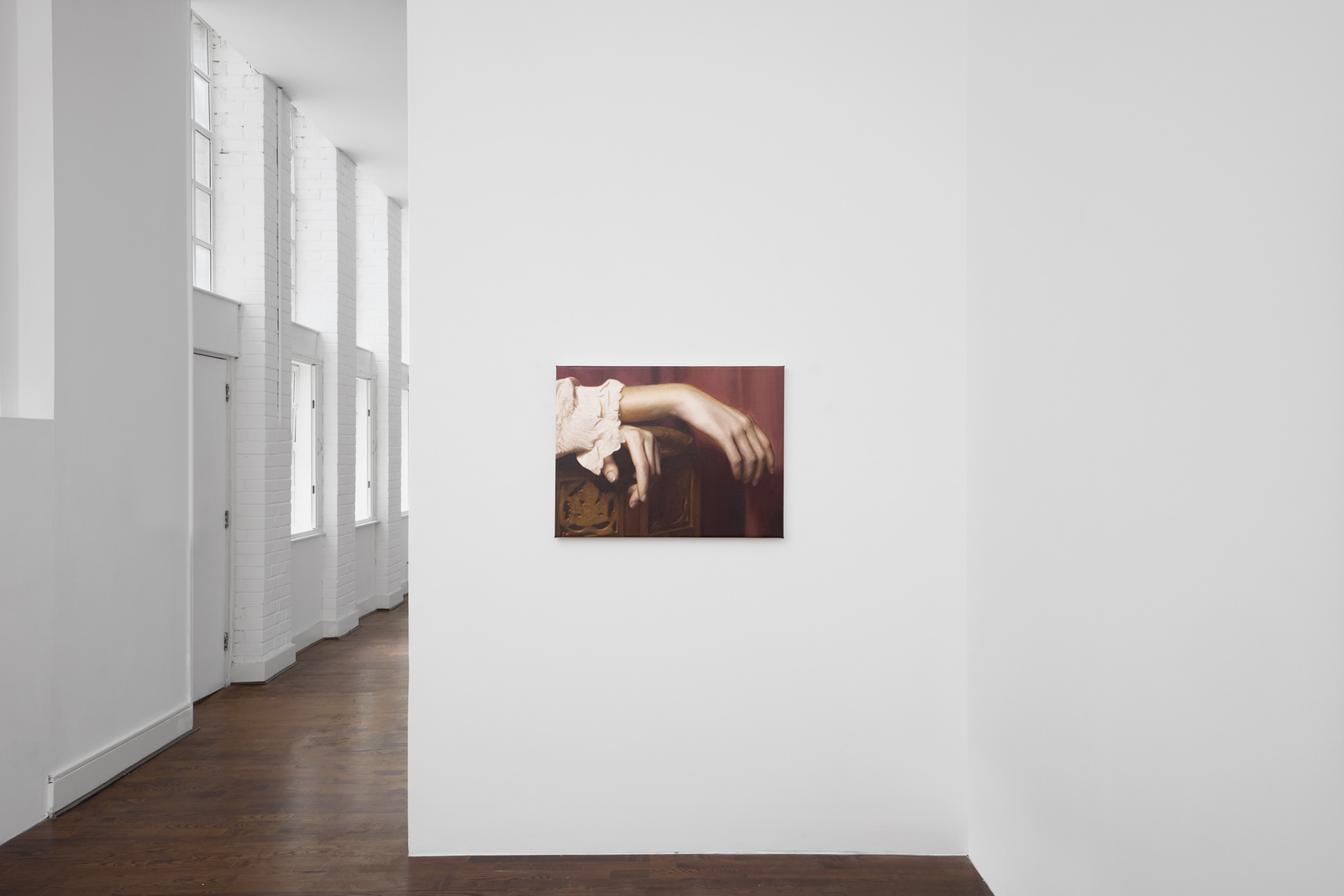
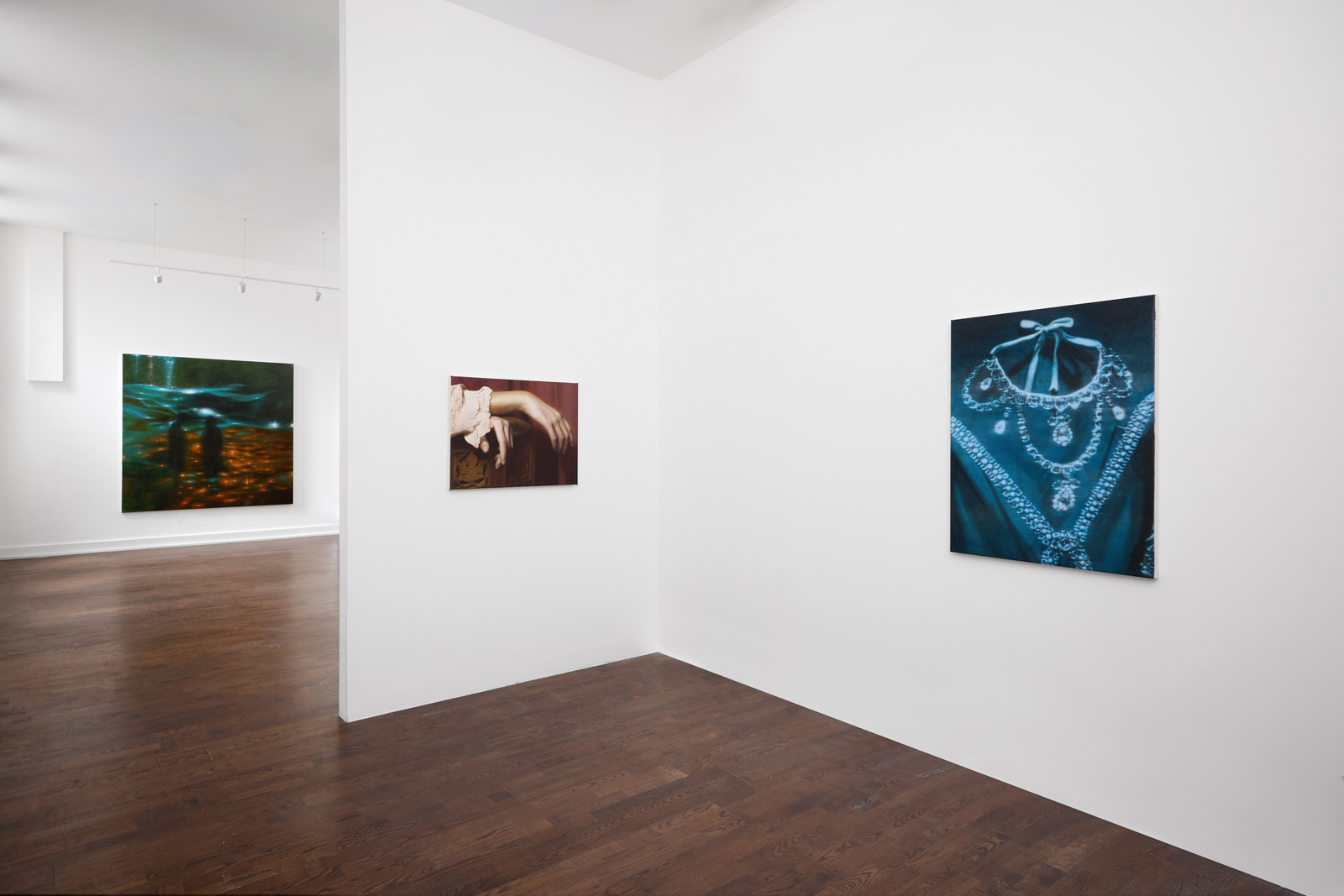
To look at Sickness and Wealth, 2026, with its title that reassigns the values of the marriage vow, is to see hands deliberately out of their own time. I’m not only thinking of the ruffled cuff that splays louchely mid-forearm, or the delicately patterned carpentry of the table, but of the gesture itself, a performatively staged pair of hands, bending, uncomfortable: this is a gesture of the past, a performance of the studied idleness that eighteenth-century portraiture required of a sitter with nothing to do. Cropped away from any face, the gesture survives as pure formula, which the German art historian Aby Warburg called the Pathosformel, the pathos formula, his term for the charged bodily gesture that outlives the culture that produced it and surfaces again centuries later in a different medium, carrying its old emotional voltage into a context that no longer knows what to do with it. Warburg tracked the wind-blown drapery of the nymph from antique relief to Botticelli; his unfinished Mnemosyne Atlas, the panels of black cloth pinned with photographs that he was still rearranging when he died in 1929, was an attempt to lay these migrations out and let the images argue with each other. Warburg’s word for their persistence was Nachleben, afterlife. Perry’s hands are a Pathosformel pinned to a panel of his own. The hand that hangs unweighted from the wrist might have gestural precedents in Sargent and Reynolds and Van Dyck; it means aristocracy, leisure, a body that has never needed to hold anything. Perry paints it, crops it, and gives it a title about sickness, lifted from the title of an Only Fools and Horses episode. Perry is a resolutely contemporary painter, because the question his hands ask is the question of images now, which is where anything we see has come from: an aristocratic pose, a sitcom episode, a scanned catalogue plate, a training set, all arriving flattened to the same depth and equally available for use.
For all of these reasons, Perry’s business is the business of image-making. This might feel like a truism, because that is of course the trade of all visual artists, but in his case there is something more at stake than the fact that he assembles his compositions from photographs. As he puts it: ‘Images can hold emotions that are difficult to put into words… But, in an age of endless reproduction, our relationship with images has changed… We consume them constantly, and their meaning can begin to dissolve.’ It would be true to say he is not the first to grapple with this question. Vermeer appears to have worked with some optical device, on the evidence of the pointillés scattered through his highlights and the circles of confusion where his focus falls away. The argument has never been settled, though the paintings look like the work of a man who had seen what a lens does to light: he was already painting what a machine sees. Then there is Walter Benjamin, of course, who in 1935 named what reproduction takes: ‘that which withers in the age of mechanical reproduction is the aura of the work of art.’ But Perry is not working in 1665 or 1935. Benjamin was writing about the photograph and the film print. We now live with something further along: the generated image, which has no negative and no sitting, and the algorithm, which now decides which images reach us.
Perry’s paintings might look reactionary against this, and there may be some truth in the charge. He works slowly, by hand, from sources that have already aged. What he asks for in return is a slower kind of looking, one that offers no next image. The doomscroll promises another picture the instant this one bores you; the dating app promises another person the instant this one disappoints. Both operate by replacing experience with the possibility of experience, and both depend on that possibility never running out. Perry’s blurred and blown and grain-eaten surfaces close it off. Nothing further is coming. What you have is what you are given, and it is always already partly gone. Perry restores the scarcity that made those moments of our lives matter, and the paintings keep it badly, blurred and imperfect and unrepeatable, singing it twice over so we won’t doubt the first time happened. The trouble is that we never doubted the experience of rapture. What we know is that we cannot lose ourselves that way twice.
Installation Views